
 LT
LT  RU
RU  EN
EN Shipbuilding and Marine Repair Automation Solutions: Reliable Motion, Measurement, and Control in Harsh Environments
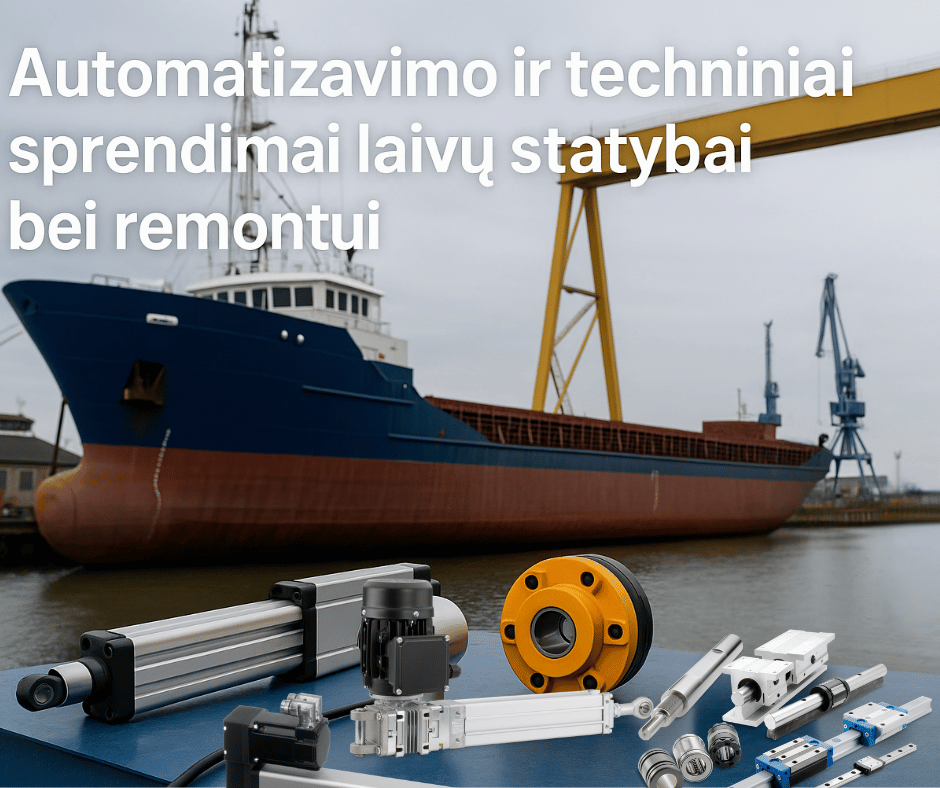
Shipbuilding and marine repair environments place extreme demands on mechanical systems, automation, and measurement technologies. High humidity, salt exposure, vibration, dust, and continuous operation create conditions where conventional industrial solutions often fail prematurely. In practice, many operational problems arise not from design errors, but from components and architectures that were never intended for real marine conditions.
This article presents an engineering-driven approach to automation and measurement for shipbuilding and ship repair, focused on robust motion systems, reliable sensing, and locally autonomous control that ensure long-term performance in demanding maritime environments.
Industrial Challenges and Operational Risks
Shipyards and repair facilities operate under tight schedules, limited access windows, and strict safety requirements. The most common real-world challenges include:
- Accelerated corrosion and wear – moisture, salt, and temperature fluctuations significantly reduce component lifespan.
- Unstable mechanical motion – vibration and load variation affect positioning accuracy and repeatability.
- Late fault detection – thermal, mechanical, or electrical issues remain unnoticed until failure.
- Manual intervention – reliance on human observation instead of diagnostic data increases risk.
- Downtime during critical repair windows – delays directly impact vessel availability and cost.
If these challenges are not addressed at the system level, the result is unplanned downtime, quality deviations, safety risks, and significant financial losses due to delayed vessel delivery or extended dry-dock periods.
Solution Architecture and Engineering Principles
Effective marine automation must be designed around environmental resilience and operational predictability, not just nominal specifications. The core engineering logic follows:
Measurement → signal acquisition → control → diagnostics → maintenance decisions
A key requirement is local autonomy. All critical control and safety functions must operate independently of internet connectivity or centralized IT systems.
Typical System Architecture for Marine Applications
- Motion systems: servo motors and electromechanical actuators with corrosion-resistant coatings.
- Mechanical components: linear actuators, ball screws, and guides selected for vibration and load cycles.
- Sensing: position, temperature, presence, and condition monitoring sensors.
- Control: PLC-based systems with deterministic response and fault handling.
- Diagnostics: monitoring of torque, current, temperature, and cycle stability.
- Safety: integrated safety systems without manual bypass modes.
Key Engineering Features and Advantages
- Corrosion-resistant design – extended service life in marine environments.
- Stable and repeatable motion – critical for lifting, positioning, and alignment tasks.
- Early fault detection – prevention of failures before they interrupt operations.
- Modular architecture – simplified maintenance and future upgrades.
- Reduced lifecycle cost – fewer failures and predictable maintenance.
Engineering Parameters and Practical Constraints
| Parameter | Typical Values | Marine Consideration |
|---|---|---|
| Protection rating | IP65–IP67 | Moisture, salt spray, washdown |
| Temperature range | -20…+60 °C | Outdoor and engine room conditions |
| Signals | DI/DO, 4–20 mA, 0–10 V, Modbus | PLC and marine system integration |
| Duty cycle | Up to 24/7 | Continuous marine operation |
Practical Field Notes
- Mounting: avoid water traps and ensure drainage paths for components.
- Cabling: use marine-grade cables and sealed connectors.
- Maintenance access: design systems for serviceability in confined spaces.
Typical Applications in Shipbuilding and Repair
::contentReference[oaicite:0]{index=0}
- Shipyard machinery – lifting platforms, positioning systems, and handling equipment.
- Dry dock systems – gates, pumps, and alignment mechanisms.
- Onboard systems – access platforms, ventilation control, and auxiliary machinery.
- Retrofit and modernization – upgrading legacy ship systems.
Integration, Commissioning, and Maintenance
Marine automation systems must be integrated and commissioned with minimal disruption to operations. A structured approach includes:
- Assessment of environmental and operational risks.
- Selection of corrosion-resistant components.
- PLC and safety logic configuration.
- Testing under realistic load and environmental conditions.
- Training of shipyard and maintenance personnel.
Common mistakes include using standard industrial components without marine protection, inadequate sealing, and insufficient diagnostics.
Why This Solution Is Preferred Over Alternatives
Basic or non-marine automation solutions may work temporarily but degrade quickly. An engineering-based marine solution is chosen because it provides:
- Operational reliability in harsh conditions.
- Improved safety for personnel and vessels.
- Predictable maintenance planning.
- Long-term cost efficiency.
Conclusion / Call to Action
Shipbuilding and marine repair require automation systems designed for reality—not laboratory conditions. Reliable motion, robust measurement, and autonomous control reduce risk and ensure stable operation throughout a vessel’s lifecycle.
Inobalt acts as a long-term engineering partner for marine projects—from system analysis and design to integration, commissioning, and support—using proven technologies from Thomson Linear, Kollmorgen, ReeR, DI SORIC, Contrinex, CS Instruments, Akytec, Optris and other trusted industrial partners.
If you are planning a new shipbuilding project or upgrading marine equipment, contact Inobalt for a technical consultation.