
 LT
LT  RU
RU  EN
EN Food and Beverage Industry Automation Solutions: Hygienic Motion, Reliable Measurement, and Process Safety
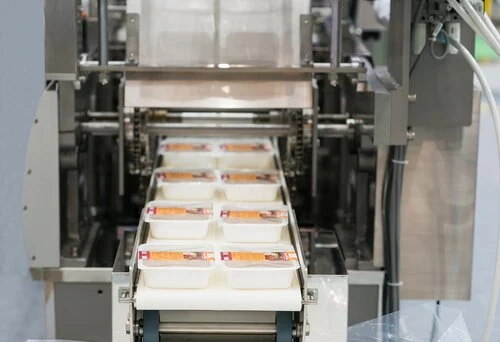
The food and beverage industry operates under some of the strictest requirements in industrial automation. Hygiene regulations, frequent washdown, temperature control, and continuous production leave no margin for unstable motion, unreliable sensing, or poorly designed control systems. In practice, most operational issues arise not from the process itself, but from automation components that were not designed for hygienic and wet environments.
This article presents an engineering-driven approach to automation in food and beverage production, focused on hygienic motion systems, reliable temperature and process measurement, and locally autonomous control that ensure product quality, food safety, and stable production.
Industrial Challenges and Operational Risks
Food and beverage production lines must meet regulatory, quality, and productivity targets simultaneously. The most common real-world challenges include:
- Hygiene-related failures – contamination risks caused by non-hygienic surfaces, seals, or water traps.
- Washdown damage – motors, sensors, and cables failing due to water, detergents, and high-pressure cleaning.
- Temperature deviations – insufficient monitoring leads to product quality loss or food safety risks.
- Unstable motion – inconsistent filling, cutting, or handling caused by poorly controlled drives.
- Manual intervention – operators compensating for unstable processes instead of relying on diagnostics.
If these risks are not addressed systematically, the consequences are unavoidable: production downtime, product waste, quality deviations, food safety incidents, and financial losses due to recalls or rework.
Solution Architecture and Engineering Principles
Automation systems for food and beverage production must be designed around hygiene, reliability, and process transparency. The core engineering logic is:
Measurement → signal acquisition → control → diagnostics → quality assurance
A critical principle is local autonomy. All safety-critical and quality-related control must operate reliably on-site, independent of internet connectivity.
Typical Automation Architecture for Food & Beverage Lines
- Motion systems: stainless steel and washdown-rated servo motors and actuators.
- Mechanical components: hygienic linear actuators and guides designed for frequent cleaning.
- Measurement: temperature sensors, infrared measurement, presence and position sensors.
- Control: PLC-based systems with validated process logic.
- Diagnostics: monitoring of temperature trends, motion stability, and cycle consistency.
- Safety: integrated functional safety for operators and processes.
Key Engineering Features and Advantages
- Hygienic design – smooth surfaces, sealed housings, and materials suitable for food contact areas.
- Washdown resistance – components rated for high-pressure and chemical cleaning.
- Precise temperature control – essential for pasteurization, cooking, cooling, and storage.
- Stable and repeatable motion – consistent filling, cutting, and packaging quality.
- Data-driven quality control – traceability and trend analysis instead of manual checks.
Engineering Parameters and Practical Constraints
| Parameter | Typical Values | Food & Beverage Relevance |
|---|---|---|
| Protection rating | IP66–IP69K | Washdown and hygiene requirements |
| Temperature range | -20…+300 °C | Cooking, pasteurization, cooling |
| Response time | <100 ms | Process stability and safety |
| Signals | DI/DO, 4–20 mA, 0–10 V, Modbus | PLC and quality system integration |
Practical Field Notes
- Hygienic mounting: avoid horizontal surfaces and water traps during installation.
- Cabling: use food-grade, washdown-rated cables and sealed connectors.
- Calibration: regular verification of temperature sensors is mandatory for food safety.
Typical Applications in Food & Beverage Industry
::contentReference[oaicite:0]{index=0}
- Filling and bottling lines – beverages, dairy, sauces, and oils.
- Food processing equipment – cooking, baking, pasteurization, cooling.
- Packaging machines – cutting, sealing, labeling, palletizing.
- Cold storage and logistics – temperature monitoring and control.
Integration, Commissioning, and Maintenance
Food and beverage automation systems must be commissioned with strict validation and documentation. A typical implementation process includes:
- Process and hygiene risk analysis.
- Selection of hygienic motion and measurement components.
- PLC and safety logic configuration.
- Validation under production and cleaning conditions.
- Operator and maintenance training.
Common mistakes include using non-hygienic components, underestimating washdown impact, and insufficient temperature validation.
Why This Solution Is Chosen Over Alternatives
Standard industrial automation often fails in food environments. An engineering-grade food & beverage solution is preferred because it provides:
- Regulatory compliance with hygiene and safety standards.
- Stable production quality.
- Lower risk of contamination.
- Reduced downtime and waste.
Conclusion / Call to Action
Food and beverage production demands automation designed for hygiene, reliability, and traceability. Stable motion, accurate temperature measurement, and autonomous control are essential for safe and efficient production.
Inobalt supports food and beverage manufacturers as a long-term engineering partner—from system analysis and design to integration, commissioning, and support—using proven solutions from Thomson Linear, Kollmorgen, ReeR, DI SORIC, Contrinex, CS Instruments, Akytec, Optris and other trusted industrial partners.
If you are planning a new food or beverage production line—or upgrading an existing one—contact Inobalt for a technical consultation.