
 LT
LT  RU
RU  EN
EN Industrial Fire Protection Solutions: Early Overheating Detection Using Thermal Imaging and Temperature Monitoring
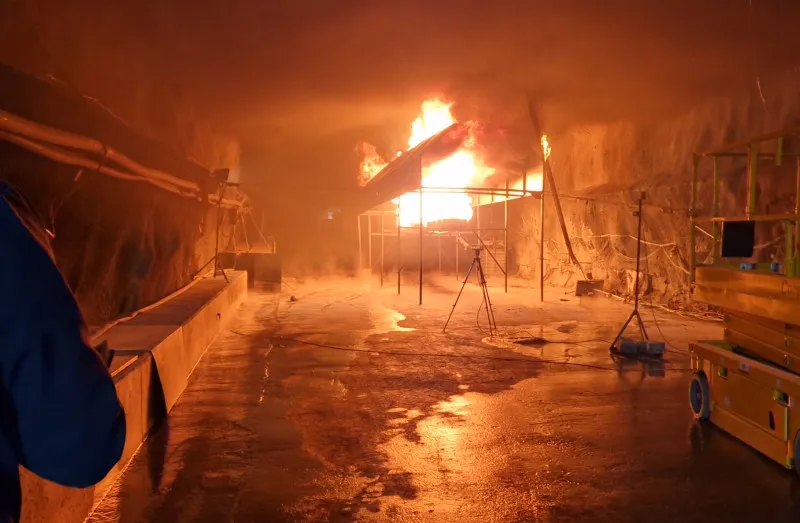
In industrial environments, fires almost never start suddenly. In most cases, they are preceded by a long and unnoticed phase of abnormal heat buildup in bearings, electrical cabinets, conveyor systems, or bulk materials. When this early stage is not detected in time, the result is unplanned downtime, severe equipment damage, and serious risk to personnel safety.
This article presents an engineering-driven approach to industrial fire protection based on continuous temperature monitoring and thermal imaging, enabling early detection of overheating long before smoke, flames, or emergency shutdowns occur.
Industrial Problem and Operational Risks
Based on real industrial experience, most fire-related incidents originate from thermal issues that remain invisible to traditional protection systems:
- Overheating of bearings and mechanical components – lubrication failure, misalignment, or excessive friction leads to gradual temperature increase that often goes unnoticed.
- Electrical faults – oxidized contacts, loose terminals, or phase imbalance create localized hot spots inside electrical cabinets.
- Self-heating of bulk materials – biomass, waste, coal, or recycled materials can heat internally without visible signs.
- Manual inspections – periodic checks cannot detect slow, continuous temperature rise between inspections.
- Late-response fire detection – smoke and flame detectors activate only after the situation has already become critical.
If early thermal anomalies are not detected, the consequences are severe: unplanned shutdowns, equipment loss, firefighting and recovery costs, production downtime, and significant safety risks.
Solution Architecture and Engineering Principles
Effective industrial fire protection must focus on prevention through early thermal detection, not only reaction to fire events. The core engineering logic is:
Temperature measurement → signal acquisition → alarm logic → diagnostics → corrective action
A critical principle is local autonomy. The system must operate reliably on-site without dependence on internet connectivity. Network access is used only for monitoring, reporting, or diagnostics.
Typical System Architecture
- Temperature measurement: non-contact infrared sensors and thermal imaging cameras for continuous surface and zone monitoring.
- Control: standalone controllers or PLCs with clearly defined alarm thresholds.
- Alarm logic: multi-level warnings (pre-alarm, alarm, critical).
- Diagnostics: temperature trends, event logs, historical data analysis.
- Safety interfaces: outputs to shutdown systems, fire suppression, or personnel warning systems.
Key Engineering Features and Advantages
- Early detection – abnormal heating is identified before smoke or flames appear.
- Non-contact measurement – no interference with moving or hazardous components.
- Area-based monitoring – thermal cameras detect temperature distribution, not just single points.
- Structured alarm hierarchy – enables controlled response instead of emergency-only shutdowns.
- Data-driven maintenance – temperature trends support predictive maintenance strategies.
Engineering Parameters and Practical Constraints
| Parameter | Typical Values | Engineering Note |
|---|---|---|
| Temperature range | -20…+1000 °C | Selected based on process and material |
| Response time | milliseconds | Critical for fast-developing events |
| Protection rating | IP65–IP67 | Suitable for industrial environments |
| Signals | 4–20 mA, 0–10 V, DI/DO, Modbus | Easy PLC integration |
Practical Field Notes
- Mounting: thermal cameras must be positioned to avoid reflections from shiny or hot background surfaces.
- Cabling: separate signal cables from power lines to avoid electromagnetic interference.
- Calibration: periodic verification is essential, especially when monitored materials or surface properties change.
Typical Industrial Applications
::contentReference[oaicite:0]{index=0}
- Conveyor systems – monitoring of bearings, drives, and belt friction.
- Electrical cabinets – early detection of overheating contacts and cables.
- Biomass and waste storage – prevention of self-ignition.
- Industrial production lines – continuous monitoring of critical components.
Integration, Commissioning, and Maintenance Notes
Integration is typically performed via PLC or standalone controllers. A structured commissioning process includes:
- Identification of critical thermal risk zones.
- Installation of thermal cameras and IR sensors.
- Configuration and testing of alarm thresholds.
- Integration with existing control and safety systems.
- Operator training and documentation.
Common mistakes include alarm thresholds set too high, unaccounted reflective surfaces, and failure to analyze temperature trends over time.
Why This Solution Is Chosen Over Alternatives
Traditional fire detection systems react only after ignition. Thermal-based early warning systems are preferred because they:
- Prevent incidents instead of reacting to them.
- Reduce large-scale fire damage and associated downtime.
- Maintain production continuity without unnecessary shutdowns.
- Deliver long-term economic value through prevention.
Frequently Asked Questions
Can thermal imaging replace smoke detectors?
No. Thermal imaging complements traditional fire detection by providing early warning before smoke develops.
Does the system work without internet access?
Yes. All critical alarm and control logic operates locally.
How much maintenance does the system require?
Minimal—primarily periodic inspection and data review.
Can it be integrated into existing PLC systems?
Yes. Standard industrial signals and protocols are supported.
What is the main return on investment?
Early fire prevention, reduced downtime, and significantly improved safety.
Conclusion / Call to Action
Industrial fire protection should start long before flames appear. Early overheating detection using thermal imaging provides visibility into hidden risks and enables preventive action before damage occurs.
Inobalt acts as a long-term engineering partner—from risk analysis and system design to integration, commissioning, and support—supplying proven solutions from Thomson Linear, Kollmorgen, ReeR, DI SORIC, Contrinec, CS Instruments, Akytec, Optris and other trusted manufacturers.
If you want to assess fire risk in your facility and implement an early warning thermal monitoring system, contact Inobalt for a technical consultation or solution proposal.