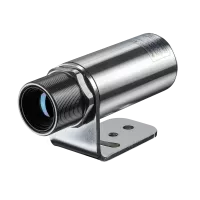
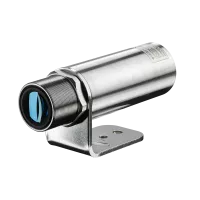
Industrial IR cameras for non-contact temperature monitoring
Infrared cameras measure temperature without contact and show the full temperature distribution of an object, surface or process area. Instead of measuring only one point, an IR camera creates a thermal image that helps detect hot spots, temperature gradients, unstable process areas and surface defects in real time.
Industrial IR thermal cameras are used where temperature directly affects product quality, machine safety, energy efficiency or process stability. They are especially useful for moving, hot, hazardous or difficult-to-reach objects that cannot be measured reliably with contact sensors.
What is the difference between an IR camera and an IR pyrometer?
An IR pyrometer measures temperature at one point or in a small measurement spot. An IR camera measures many points at the same time and creates a temperature map. Therefore, a pyrometer is often sufficient for simple point temperature measurement, while an IR camera is the better choice when the user needs to observe a surface, detect hot spots, monitor a process zone or analyse temperature distribution.
The right choice depends on the application. If one temperature value at a clearly defined spot is enough, a pyrometer may be sufficient. If the process requires monitoring a surface, strip, casting, plate, weld, machine area or multiple objects at the same time, an IR camera is usually more suitable.
Main Optris IR camera groups
Xi series IR cameras
Optris Xi series cameras are compact industrial thermal imagers designed for process monitoring and automation. This series is useful when thermal measurement must be combined with easier integration into production systems, hot spot detection or more autonomous operation.
PI series IR cameras
Optris PI series cameras are used where detailed radiometric thermal analysis, higher resolution or advanced analysis with PIX Connect software is required. They are suitable for quality control, laboratory tasks, production process investigation and continuous industrial temperature monitoring.
High-temperature cameras for metals
High-temperature Optris cameras such as PI 1M, PI 05M, PI 08M and Xi 05M are designed for metals, casting, forging, welding, heat treatment and other high-temperature processes. In these applications it is especially important to select the correct wavelength, temperature range, optics and protective accessories.
Special cameras for glass, plastics and films
Different materials emit and reflect infrared radiation differently, so wavelength selection is critical for accurate temperature measurement. Glass, thin films, plastics or very hot metals may require specialized IR cameras that match the optical properties of the material.
PIX Connect software and process analysis
Optris IR cameras are used with PIX Connect software, which allows users to view thermal images in real time, define measurement areas, set alarms, record data, export results and analyse process changes. This is important when an IR camera is used not only for visual inspection, but also as part of measurement, monitoring and process control.
In practice, this makes it possible to detect hot spots automatically, monitor several measurement zones, react to limit violations and transfer information to operators or control systems.
Where are IR thermal cameras used?
Industrial IR cameras are used in many applications where temperature must be monitored continuously, quickly and without contact.
- Metal casting, forging and heat treatment processes;
- Plastic extrusion, thermoforming and film production;
- Glass manufacturing and hot surface monitoring;
- Electronics, battery and component testing;
- Food, packaging and sealing processes;
- Fire prevention, equipment protection and hot spot detection;
- Laboratory research and quality control;
- Production line monitoring and automated process control.
How Inobalt helps select an Optris IR camera
When selecting an IR camera, it is important to know the measured material, temperature range, object size, measurement distance, required resolution, field of view, ambient temperature, dust or steam level, mounting position, software analysis needs and integration with the control system.
Inobalt helps evaluate these parameters and select the suitable Optris IR camera, optics, protective housing, cooling, air purge, cables and software solution.
Need help selecting an IR camera for temperature monitoring?
Send us information about the measured object, temperature range, distance to the object, environmental conditions and required integration. We will help select the right Optris IR camera and accessories for your process.

 LT
LT  RU
RU  EN
EN